Starting Your Engine
VETuner aims to help you start your engine for the first time. You've done a scary thing, you've done a brain transplant on your engine and now it needs to live. All the bravado and bluster disappears and the tension mounts as you turn the key or press the button for the first time. It is scary, and to be honest it probably isn't going to work.
Use this page as your practical getting-started flow:
- Establish a stable ECU connection
- Run the initial sanity checks
- Use Start Doctor if it does not fire
- Stay in Focus Mode until it idles cleanly
VETuner assumes you have already worked through at least this check list
- You have read all the pertinent documentation for Speeduino or MegaSquirt
- You have fuel in the tank
- You have a fully charged battery
- All your hoses and electrical connections are tight.
- You have really checked your hoses as petrol at 40psi squirting across your garage onto an ignition source is not fun
- The right spark plug is connected to the right lead.
- You have a fire extinguisher to hand.
- Have you checked your hoses for leaks?
Establishing a Connection
VETuner only supports Speeduino and MegaSquirt-derived ECUs. Connection is via Web Serial in Chrome or Edge.
- Plug in your ECU USB/serial cable and turn ignition on.
- Open Connection Setup and click Connect ECU.
- When the browser permission prompt appears, choose the correct serial device.
- Wait for signature detection and page read to complete.
If all goes well, VETuner will recognise the ECU, load the matching INI definition, and pull the current configuration from the ECU.
If auto-detection does not complete:
- Confirm ignition is on and ECU has power (and grounds).
- Reconnect the cable and try a different USB port.
- Close other tuning tools that may already have the serial port open.
- Manually load the INI via Files → Load Manual INI. (and then email it to admin@vetuner.co.uk so I can add it to the collection)
Connection guide with more detail: Connecting to your ECU.
Focus Mode
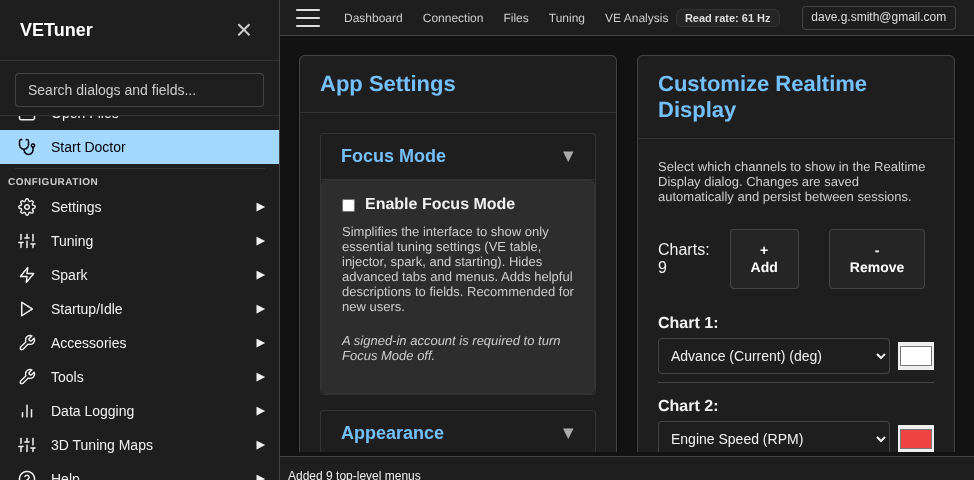
By default, VETuner will run in Focus Mode. This removes a lot of the 'noise' from the user interface of things that you don't need to get your engine running. It focusses on the fundamentals of
- Spark settings
- Fuel settings
- Cranking and starting settings
 If those aren't right, there is no point worrying about VE tuning, acceleration enrichment, boost control, DFCO or all the other things you can tweak; if the engine doesn't run. Get the engine running, idling and warm before anything else.
VETuner automatically checks your ECU configuration for common problems when you connect. See the Configuration Health Check guide for the full list of checks and how to fix them.
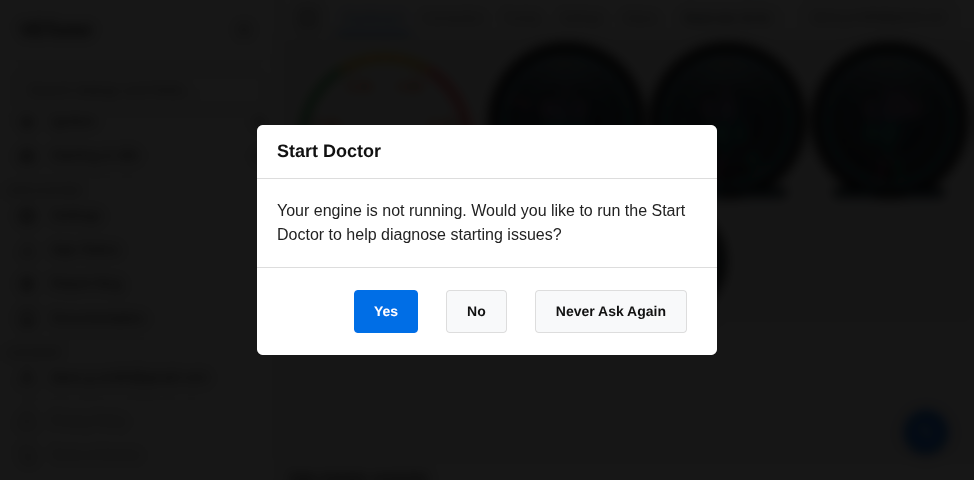
Start Doctor
The Start Doctor watches what happens as you crank the engine and looks for common problems - battery voltage drop, a missing crank signal, implausible sensor readings, electrical noise, ECU reboots, and whether the injector pulse width and ignition advance are in the right ballpark. It automatically captures and downloads a log file while it runs, so if you get stuck you can share it with others to help diagnose what is going wrong. Check your Downloads folder afterwards to find it.
It Won't Start - Now What?
Don't panic. It is very normal for an engine not to fire on the first attempt. Work through the Start Doctor findings one at a time. Here are the most common culprits:
- No crank signal - the ECU cannot see the engine turning. Double-check your trigger wheel sensor wiring, air gap and the trigger angle setting in the firmware.
- Wrong trigger pattern - make sure the trigger type, tooth count and missing tooth count match your actual trigger wheel.
- Flooded - if you have been cranking a lot without success there may be too much fuel in the cylinders. Hold the throttle wide open (flood-clear mode) and crank until it clears. Be aware that when doing this the engine can suddenly start and rev as you've got your foot to the floor. Don't panic, switch off and revel in the sweet noise you just made. Bonus points if it is 2am and your neighbour has just got their baby to sleep1
- No spark - Remove a spark plug and earth it against the engine, crank and see if it sparks. A bad coil driver setting or wrong dwell time is a common cause.
- No fuel pressure - listen for the fuel pump priming when you turn the key. If you hear nothing, check the pump fuse and relay first.
- Electrical noise - the Start Doctor will flag this if it spots it. Ignition systems are brutal sources of electrical interference and can corrupt the crank signal, causing misfires or a complete refusal to run. The most common fixes are a dedicated star-point earth on the ECU, shielded cabling for the crank and cam sensors, and keeping sensor wiring well away from HT leads and coil packs. Resistor spark plugs and suppressed HT leads are not optional on an EFI conversion - if you have straight copper leads or non-resistor plugs, change them.
It Started! What Now?
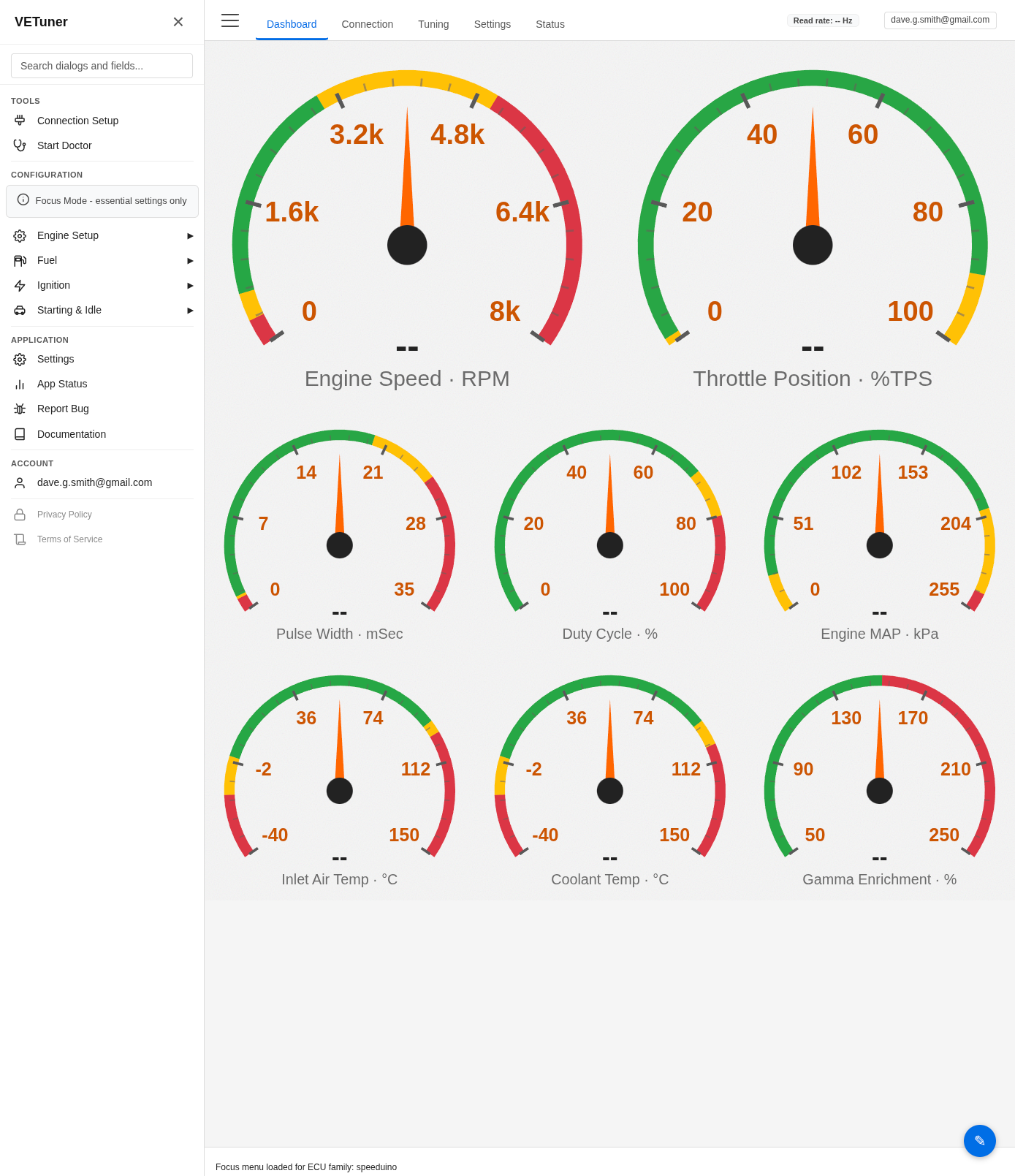
Congratulations - that is genuinely exciting. Now resist the urge to rev it. Let it idle and watch the gauges in VETuner.
Coolant Temperature
It should be reading something believable. An implausibly high reading at a cold start usually means the sensor wiring is reversed or the wrong sensor type is selected in the firmware.
Idle Speed
Is the engine idling at something recognisable as an idle? Very high idle (above 2000 RPM) can mean a vacuum leak - check your hoses again. Very low and hunting idle usually means the cranking enrichment is bleeding away too quickly or the idle air control valve isn't set up yet.
AFR / Lambda
If you have a wideband O2 sensor connected2, watch your AFR at idle. It should be somewhere in the 13–15:1 range. If it is very lean (above 16:1) the engine will hunt and may stall. If it is very rich (below 12:1) it will smoke, foul plugs and smell.
Oil Pressure
You do have an oil pressure sender, right? Keep a very close eye on this in the first few minutes of running. If oil pressure does not come up quickly, shut it down immediately.
Warming Up
Let the engine warm up fully at idle before driving it anywhere. Watch the coolant temperature rise steadily through 70–90 °C. While it warms up, notice how the idle changes - most engines need progressively less fuel enrichment as they warm up. VETuner's Warm-Up Enrichment (WUE) table controls this.
If the idle speed drops and the engine stalls as it warms up, it usually means the afterstart enrichment table is set too aggressively and needs trimming back, or the idle valve needs tuning, or idle advance.
First Drive
Once the engine is warm and idling stably you can take it for a very short, gentle drive - no more than 5–10 minutes, staying close to home.
- Keep RPM modest - under 3000 RPM.
- Watch for overheating. The cooling system may have air locks that only clear once the thermostat opens.
- Listen for any unusual knocking, rattling or hissing.
- If anything seems wrong, pull over and investigate before continuing.
After the first drive, let the engine cool down and check under the bonnet for any fresh leaks, loose hoses or flames.
Getting Ready for VE Tuning
Once you have a warm, stable idle and can drive the car gently without problems, you are ready to start properly tuning the VE (Volumetric Efficiency) table. This is where VETuner really comes into its own.
The VE table controls how much fuel the ECU injects across all engine speeds and loads. Getting it right means better power, better economy and a cleaner-running engine. VETuner can analyse a driving log and suggest corrections to the VE table automatically - but that is a topic for the VE Tuning section.
Related guides
- Connecting to Your ECU - detailed connection setup and serial troubleshooting.
- Start Doctor - guided diagnostics during cranking and early running.
- VE Analysis - next step once idle and warm-up are stable.